Restaurant kitchens
Work tables, shelves, sinks and counters in one grade and finish, sized to the line.

Stainless steel is the standard material for commercial kitchen equipment because it resists corrosion, wipes clean and does not absorb food or odours. SUS304 is the usual grade, SUS316 suits heavy salt and chlorine exposure, and FIAMMA supplies SUS304 cooking, cooling, washing and custom-fabricated equipment in Dubai.
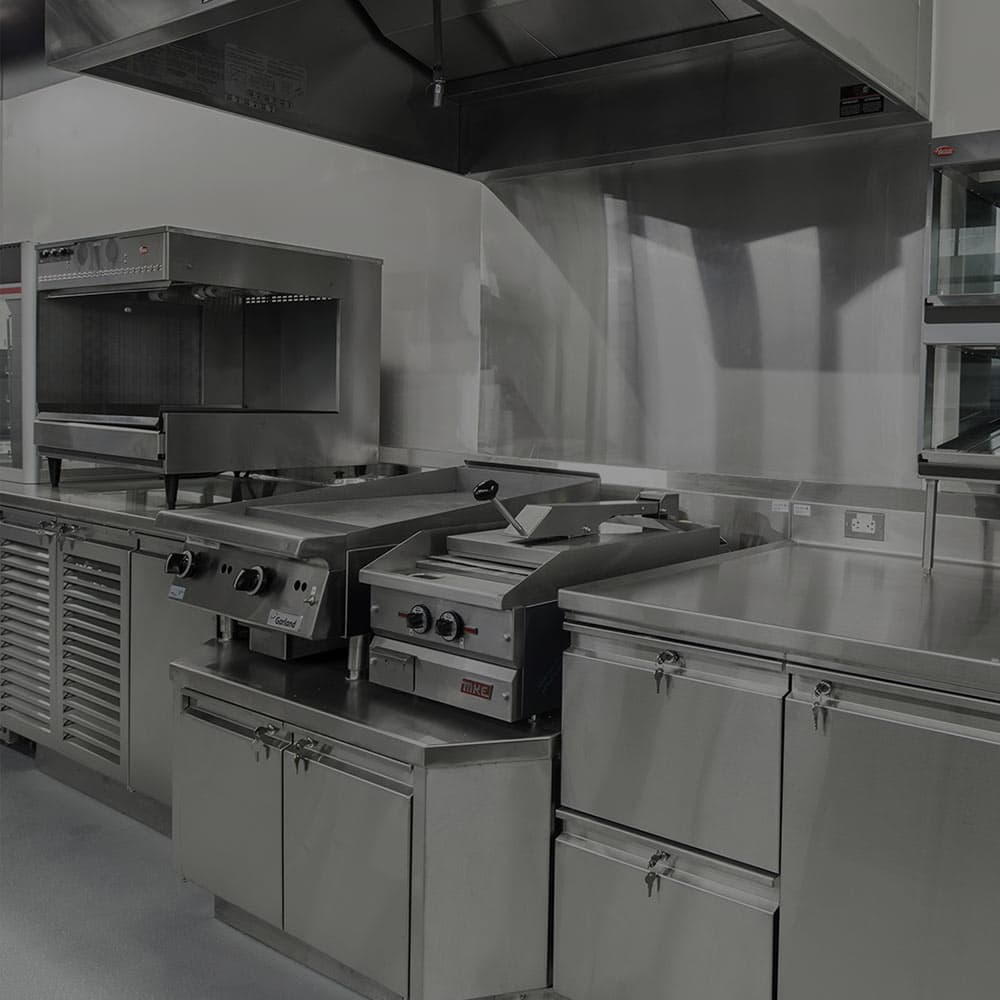
Almost every kitchen equipment quotation in Dubai says stainless steel. Far fewer say which grade, how thick, how it is welded or what finish it has, and those details decide whether a table is still flat and clean after three years of daily washing. This page covers what to ask and what to look at, in plain terms.
FIAMMA's standard material is SUS304, across cooking, cooling, washing and custom-fabricated lines. Below you will find why stainless suits a kitchen, what 304, 316 and 430 mean, how thick each item should be, what to inspect before you accept delivery, how UAE humidity, salt and cleaning chemicals affect steel, and how to look after it. If you already have a drawing, send it through the contact page. For the grade question on its own, see our SUS304 vs SUS316 guide.
Stainless steel is not the cheapest material for a work table or a shelf, but over a few years it is usually the cheapest to own. Here is what it gives a kitchen:
SUS is the Japanese standard's prefix. SUS304 is what is called 304, or AISI 304, in most other places. The grade is the first thing to ask about, because it decides how the steel behaves in your kitchen:
Two choices shape how the piece looks and wears. The finish is the surface texture. The thickness is the sheet gauge, quoted in millimetres or in gauge numbers: about 1.2 mm is close to 18 gauge and about 1.5 mm is close to 16 gauge. Finishes first:
| Item | Typical thickness | Why |
|---|---|---|
| Work table and infill table tops | about 1.2 to 1.5 mm | Stays flat under chopping and heavy pots when it has reinforcement underneath. |
| Pass and pick-up counter tops | about 1.5 mm | Plates, trays and people leaning on it all day. |
| Sinks and wash basins | about 1.0 to 1.5 mm | Formed bowls. Heavier gauges for heavy pot-wash duty. |
| Wall shelves and cabinets | about 1.0 to 1.2 mm | Strength comes from the folds and brackets as much as from the sheet. |
| Hoods and ducting | about 1.0 to 1.2 mm | Heat and weight above the cooking line. FIAMMA's extraction hood is listed at 1.2 mm. |
| Equipment side panels and doors | about 0.8 to 1.0 mm | Often double-skinned for stiffness. |
Two pieces of stainless with the same grade and thickness can be very different products. Check these before you accept delivery, or ask for photos before you order:
| Item | What good looks like | Red flag |
|---|---|---|
| Welds | Continuous, ground smooth and blended into the finish, with heat tint removed. | Pinholes, gaps, rough beads, rainbow discolouration left on the metal. |
| Edges and corners | Folded or hemmed edges and rounded corners with no burrs. | Raw cut edges, sharp corners, visible burrs. |
| Worktop surface | Flat, even grain, no ripples, with a sound-deadening under-panel. | A hollow drumming sound, waves in the sheet, thin unsupported spans. |
| Feet and legs | Adjustable stainless feet and tubular legs with bracing. FIAMMA's infill table is listed with 40 × 40 mm tube legs and bullet feet adjustable up to 50 mm. | Painted or plated feet, wobble, no levelling. |
| Backsplash and wall joint | A turned-up backsplash (100 mm on FIAMMA's infill table) sealed to the wall. | A gap behind the table where water and food collect. |
| Sinks and drains | A sloped bowl that drains fully and rounded internal corners. | Flat bowls that hold water and sharp internal corners. |
| Fixings and hidden parts | Stainless fasteners and brackets. | Zinc-plated bolts or hidden carbon steel that rust and stain the stainless. |
It can. Stainless resists corrosion, it does not ignore it. In UAE kitchens, four things do most of the damage:
Daily care costs almost nothing and does more for the life of the equipment than the choice of grade.
SUS304 is the standard across the range, with a few exceptions that we say plainly. This is what each product page lists:
| Line | Equipment | Stainless detail listed |
|---|---|---|
| Custom fabrication | Infill work table | SUS304, 1.2 mm, 40 × 40 mm tube legs, adjustable bullet feet, 100 mm backsplash, sound-deadening under-panel. |
| Custom fabrication | Pick-up counter | SUS304 with a 1.5 mm top, smooth satin finish, steel channel reinforcement. |
| Custom fabrication | Wall-mounted shelf and sliding-door wall cabinet | SUS304. Shelf at 1.2 mm with folded safe edges. Cabinet with double-skinned sliding doors. |
| Extraction | Kitchen extraction hood | SUS304, 1.2 mm, removable baffle filters, welded drip channel. |
| Cooking | Combi oven, double-well fryer and gas cooking range | SUS304 listed. The combi oven is SUS304 inside and out, and the range has a SUS304 frame. |
| Cooling | Upright freezer, meat chiller and pastry display chiller | SUS304 listed. The freezer is SUS304 inside and out. |
| Washing | Pedal-operator sink, hood-type dishwasher and grease trap interceptor | SUS304 listed. The sink is 1.2 mm with a 150 mm backsplash. |
| Preparation | Food processor, precision meat slicer | Mixed materials. The food processor has a SUS304 bowl with anodised aluminium. The slicer body is anodised aluminium alloy, not stainless. |
Standard catalogue sizes waste space in an odd-shaped kitchen. Custom fabrication helps most where equipment has to fill a gap, follow a wall or match a line: infill tables between heavy appliances, pick-up counters, wall shelving cut to the wall length, sink units, and kitchen hoods that run the full length of the cooking line, from 1.2 m to 6 m and more. FIAMMA's custom-fabricated lines are made to your drawing, in SUS304, so a whole kitchen matches. See our pages on custom kitchen fabrication and commercial kitchen cabinets.
A typical custom order runs like this:
Work tables, shelves, sinks and counters in one grade and finish, sized to the line.
Long runs of tables and counters that have to survive daily wash-down and constant traffic.
Flat, easy-clean tops for dough and pastry work, with shelving above.
Compact stations where every centimetre counts, so equipment is made to the exact gap.
Wet, salty and heavily washed areas, where the grade and the welds matter most and 316 is worth discussing.
Salt air attacks the oxide layer, so grade, finish and a rinsing routine all count.
The product lines are listed in SUS304, so the kitchen matches from the cooking line to the sink.
Product pages state sheet thickness, for example 1.2 mm on the infill table and extraction hood and a 1.5 mm pick-up counter top.
Folded edges, welded corners, adjustable feet and backsplashes are listed on the product pages, so you can inspect them on delivery.
Custom-fabricated tables, counters, shelves and hoods follow your layout, not a catalogue size.
We tell you when 304 is enough and when to discuss 316, instead of upselling either.
Equipment from the FIAMMA range that goes with this page.

Custom manufactured stainless steel infill work table. Ideal for filling gaps between heavy cooking appliances or creating dedicated prep stations. Constructed from premium heavy-gauge SUS304 stainless steel with sound-deadening under-panel reinforcement, adjustable bullet feet, and a rear backsplash to keep walls clean.

Custom-made pass-through pickup counter for food presentation and plating. Engineered with a smooth satin-finish top, heavy-duty structural frame, and integrated overhead pass shelf options. Easily integrates hot cupboards, neutral storage, or drawer units below.

High-strength wall mounted shelving units for commercial kitchens, pantries, and dishwashing areas. Designed to maximize overhead storage. Heavy-duty brackets ensure a stable hold under heavy kitchen loads. Smooth rounded corners prevent safety hazards.

Enclosed wall-mounted storage cabinet featuring smooth-sliding double doors. Ideal for keeping spices, chinaware, and small prep tools protected from dust and airborne oils. Built with an internal adjustable shelf and secure wall mounting rails.

Heavy-duty SUS304 stainless steel extraction canopy engineered for high-heat commercial cooking lines. Integrated baffle grease filters, welded drip channels, and an optional built-in water mist fire suppression manifold contain grease-laden vapor and suppress flare-ups at the source, keeping kitchens compliant with UAE Civil Defence fire-safety codes.

Hygienic hands-free wash basin with integrated foot pedal operation. Specifically designed to meet HACCP food safety standards in prep areas, kitchens, and toilets. Comes complete with a stainless steel gooseneck faucet, soap dispenser mount, and rear splashback.
Send your layout and equipment list. We will confirm grade, thickness and finish for each item and come back with a drawing and a quotation.
Last updated: