Restaurants and hotel kitchens
Indoor, air-conditioned kitchens are well served by SUS304 worktops, shelving, cabinets and hoods.

SUS304 (about 18/8 stainless) is the standard for commercial kitchens and handles almost everything indoors. 316 adds molybdenum for better resistance to chlorides, so it is worth paying for near the coast, outdoors, around brine or pickling, or with heavy chlorine cleaning. FIAMMA's standard is SUS304; ask us about 316 for specific projects.
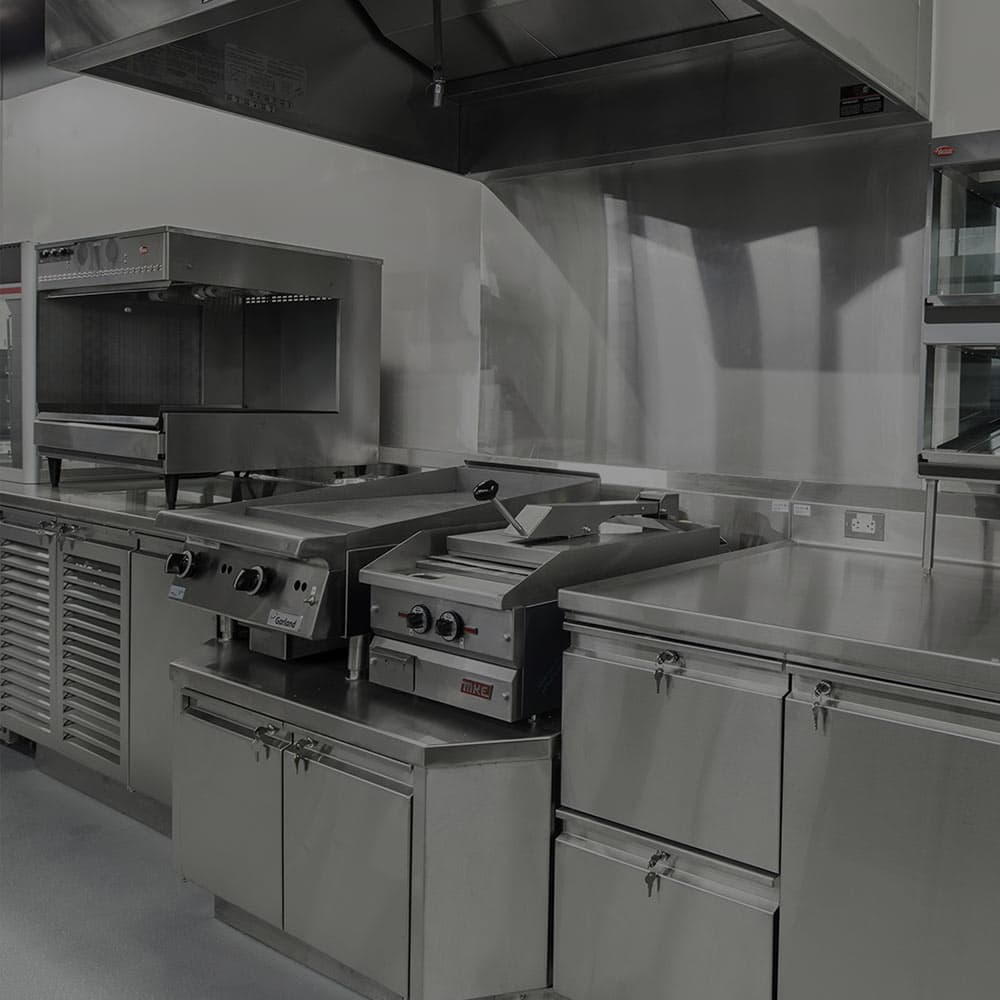
Almost every quotation for stainless steel kitchen equipment says "stainless steel", and some say "SUS304" or "316", but the grade is the single biggest factor in how a counter, shelf or hood looks after three years of washing in humid UAE air. It is also where quotations quietly differ: two tables of the same size can be made from very different metal, and from the outside you often cannot tell.
This guide explains the difference between the grades in plain words, where 316 is worth the extra cost and where 304 is plenty, how to spot cheaper grades, what sheet thickness to ask for, and how to ask a supplier to prove what they are selling. For the wider range of what we supply, see our page on stainless steel kitchen equipment, or send us a drawing for custom fabrication.
Stainless steel is iron with at least about 10.5 percent chromium. The chromium forms a thin invisible layer on the surface that heals itself when scratched, and that layer is what stops rust. Everything else in the recipe adjusts how well it resists particular kinds of attack.
304 (called SUS304 in the Japanese JIS naming that FIAMMA uses, and AISI 304 or EN 1.4301 elsewhere) contains roughly 18 percent chromium and 8 percent nickel, which is why it is also called 18/8. Nickel keeps the metal tough and easy to form, and it gives the smooth, non-porous surface that food kitchens need. 316 has the same base plus about 2 to 3 percent molybdenum, and a little more nickel. Molybdenum is the difference that matters: it makes the protective layer far harder for chlorides, such as salt, to break down.
The table below gives rounded, typical figures. Always rely on the figures in the mill certificate for the actual sheet.
| Grade | Main alloying elements (typical) | Resists corrosion | Magnet sticks? | Typical use |
|---|---|---|---|---|
| 304 / SUS304 | About 18% chromium, 8% nickel | Very well in normal kitchens, water and most food acids | Mostly no; slightly after bending or welding | Worktops, sinks, shelving, hoods, cabinets, prep and washing equipment |
| 316 / SUS316 | About 16-18% chromium, 10-14% nickel, 2-3% molybdenum | Better again against salt, chlorides and many chemicals | Mostly no | Coastal and outdoor kitchens, brine and pickling, marine, chemical areas |
| 430 | About 16-18% chromium, little or no nickel | Fair indoors; marks and rusts more easily in damp or salty kitchens | Yes, strongly | Cheaper appliance panels, some decorative or dry-area trim |
| Low-nickel (200-series) | Less nickel, more manganese | Looks like 304 at first but is more likely to stain and rust | Weakly, often more after forming | Budget products sold as "stainless steel" |
Stainless steel does not fail because it is hot. It fails because of chlorides and moisture sitting on its surface, and the UAE offers plenty of both.
316 costs more because of the extra nickel and the molybdenum, and sheet in some sizes and thicknesses can be harder to source than 304. Pay for it where chlorides are a real part of the job, not just because it sounds better.
316 is worth considering for:
430 is a ferritic stainless steel with little or no nickel. It costs less, is magnetic, and is perfectly reasonable for dry, decorative panels. It is not a good choice for sinks, wash areas, or anywhere that stays wet, because it marks and rusts more easily than 304. Low-nickel "200-series" steels are the other common substitute. They can look identical to 304 when new.
The most common trick is selling a cheaper grade in a quotation that only says "stainless steel". Here are the checks, from quick to reliable:
| Check | What it tells you | Limits |
|---|---|---|
| Magnet test | A strong pull points to 430. 304 and 316 are mostly non-magnetic. | Not proof. 304 can turn slightly magnetic at bends and welds, and some low-nickel grades are only weakly magnetic. |
| Written grade in the quotation | "SUS304, 1.2 mm" is a commitment. "Stainless steel" is not. | Only as honest as the supplier. Pair it with a certificate. |
| Mill test certificate | Lists the chemical composition and heat number of the sheet. | Check that the heat number matches the material used on your job. |
| Handheld analyser (PMI) or lab test | Measures the alloy on the finished item. | Costs a little, but it is the most direct proof, especially on a large order. |
| Price far below others | Often a sign of a cheaper grade or thinner sheet. | A clue, not proof. Always ask for grade and thickness in writing. |
Thickness matters as much as grade. Thin sheet drums, dents and warps near heat, while sheet that is thicker than needed adds weight and cost with little benefit. The values below are typical, not rules, and the right figure depends on span, load and design.
| Item | Typical thickness | Notes |
|---|---|---|
| Hoods and canopies | About 1.0 to 1.2 mm | Our extraction hood is SUS304 at 1.2 mm, per its product page. |
| Work tables and counters | About 1.2 to 1.5 mm top | Fixings, stiffeners and a sound-deadened underside matter. Our infill table uses 1.2 mm SUS304. |
| Sinks and wash stations | About 1.2 to 1.5 mm | Deep drawn or fully welded bowls are the easiest to keep clean. |
| Shelving and wall cabinets | About 1.0 to 1.2 mm | Check the rating for load and the way brackets are fixed. |
| Heavy-duty areas | About 1.5 to 2.0 mm | Pot-wash tables, chopping and butchery areas, high-impact surfaces. |
Two products made from the same grade can corrode at very different rates because of how they were finished. The surface and the welds are where stainless steel is most at risk.
You do not need to be a metallurgist. You need to ask for the same few things every time and notice if the answers are vague.
Even the best grade needs a basic routine. The aim is simple: keep chlorides and food residues from sitting on the surface.
Use this as a starting point and confirm for your specific site.
| Where it will be used | Sensible choice | Why | Look at |
|---|---|---|---|
| Indoor, air-conditioned restaurant or hotel kitchen | 304 | Excellent resistance for normal food and cleaning | Stainless steel kitchen equipment |
| Cabinets, shelving and prep tables | 304 | Standard grade, good value, easy to fabricate | Commercial kitchen cabinets |
| Hoods and extraction over cooking lines | 304 | Heat plus grease; sheet thickness matters more than grade | Kitchen hoods |
| Sinks, pot-wash and grease traps | 304 in most cases | Constant water; welds and finish matter most | Grease traps |
| Waterfront or coastal sites, exposed to salt air | 316 worth considering | Better resistance to chlorides | Ask us about 316 for specific projects |
| Brine, pickling or seafood processing | 316 worth considering | Direct chloride contact | Ask us about 316 for specific projects |
| Outdoor BBQ, marine or rooftop kitchens | 316 worth considering | Rain, salt and no air conditioning | Ask us about 316 for specific projects |
| Dry decorative panels | 430 can be acceptable | Lower cost where moisture is not an issue | Not for wet or wash areas |
Indoor, air-conditioned kitchens are well served by SUS304 worktops, shelving, cabinets and hoods.
Heavy daily washing makes thickness, welds and finish more important than upgrading the grade.
Direct chloride contact is where 316 earns its extra cost.
Salt air reaches exteriors, so grade, finish and a regular rinse all matter.
Rain, dust and salt with no air conditioning make 316 worth discussing.
Compact fit-outs with standard cleaning routines do well with SUS304 and good welds.
FIAMMA's hoods, tables, shelves, cabinets and interceptors are specified in SUS304 stainless steel.
Product pages state sheet thickness where it matters, for example 1.2 mm on the extraction hood and the infill table.
Custom-fabricated items are made to your drawing, so the grade and gauge are agreed with the size.
If your site needs a different grade, we will say what is and is not possible rather than guessing.
Finish, welds and cleaning routine are part of the discussion, not an afterthought.
Equipment from the FIAMMA range that goes with this page.

Heavy-duty SUS304 stainless steel extraction canopy engineered for high-heat commercial cooking lines. Integrated baffle grease filters, welded drip channels, and an optional built-in water mist fire suppression manifold contain grease-laden vapor and suppress flare-ups at the source, keeping kitchens compliant with UAE Civil Defence fire-safety codes.

Custom manufactured stainless steel infill work table. Ideal for filling gaps between heavy cooking appliances or creating dedicated prep stations. Constructed from premium heavy-gauge SUS304 stainless steel with sound-deadening under-panel reinforcement, adjustable bullet feet, and a rear backsplash to keep walls clean.

Under-sink or in-line stainless steel grease trap engineered to intercept fats, oils, and grease before wastewater reaches municipal drainage. Baffled internal chambers slow flow to separate FOG from water, helping commercial kitchens meet UAE municipality drainage compliance and avoid blocked lines.
Send your drawing, the site location and how it will be cleaned. We will confirm the grade and thickness and come back with a quotation.
Last updated: