Types of Commercial Ovens: Which One Should You Buy?
A combi oven cooks with steam and dry heat for varied menus. A convection oven is a simpler fan-and-heat unit for baking and roasting. Deck ovens bake bread and pizza on stone, rotary rack ovens bake large batches, and tunnel ovens run continuously. Match the oven to your menu and volume. FIAMMA supplies a combi oven and a stone-hearth deck oven.
Buying the wrong oven is an expensive mistake, because an oven shapes the whole line around it: the hood above it, the power or gas behind it, the trays you buy and sometimes even the menu. A restaurant that needs a combi and buys a convection oven loses steam control. A bakery that needs a deck and buys a combi gets bread that is cooked but never quite crusty.
This guide walks through the six types you will meet in the UAE, how each one cooks, how to measure its capacity, what it needs behind it, and which kind of business it suits. If you already know roughly what you need, you can go straight to the commercial ovens page or ask for a quotation. If you run a bakery, read it alongside our bakery equipment guide.
What types of commercial oven are there?
Six families cover almost every commercial kitchen and bakery. They differ in how heat reaches the food, and that decides what each does best.
Commercial oven types at a glance
Oven type
How it cooks
Capacity measured in
Best for
Combi oven
Fan-forced hot air, steam, or both together
GN 1/1 or GN 2/1 levels (for example 6, 10 or 20)
Restaurants, hotels and caterers with a varied menu
Convection oven
Fan-forced hot air only
Sheet pans, commonly 600 x 400 mm
Cafes, pastry and cookies, roasting, small bakeries
Deck oven
Top and bottom heat through a stone or steel deck
Trays per deck, and number of decks
Artisan bread, flatbread, pizza, patisserie
Rotary rack oven
A full trolley rotates in a hot-air chamber
Trays per trolley, trolleys per hour
Production bakeries and supermarkets baking in batches
Tunnel or conveyor oven
Food travels through on a belt
Belt width and pieces per hour
High-volume bakeries, pizza chains, central production
Pizza oven
Very hot stone deck, gas, electric or wood
Pizzas per hour, and deck diameter
Pizzerias that want a high-heat, fast bake
Combi oven vs convection oven: what is the real difference?
A convection oven is a heated box with a fan that moves hot air around the food, so it browns evenly and cooks faster than a still-air oven. A combi oven adds a steam system and controls humidity, so it can steam, bake dry, or do both in the same cycle.
That steam is the whole point. It keeps meat juicy during roasting, regenerates plated banquet food without drying it, steams vegetables and rice, and gives a better crust on some breads. A convection oven cannot do any of that, but it is simpler, cheaper to buy and has no water connection to maintain.
Choose a combi if one oven must roast, steam, bake and regenerate across a varied menu, or if labour and consistency matter more than purchase price. Our commercial combi oven holds 10 GN 1/1 trays, runs from 30 to 300 °C, and is available in electric or gas.
Choose a convection oven if your menu is mostly baking, reheating and roasting, you want the lowest purchase cost and you do not want to manage water supply or scale.
Cost drivers. A combi costs more because of the steam generator, the controls, the self-cleaning system and the sensors. The decision is usually about what the extra control saves you, not the oven price on its own.
Watch the maintenance. A combi needs a water supply, a drain and a descaling routine suited to your local water quality. Ask what the supplier recommends for treatment before you buy.
Deck oven vs rotary oven: which suits a bakery?
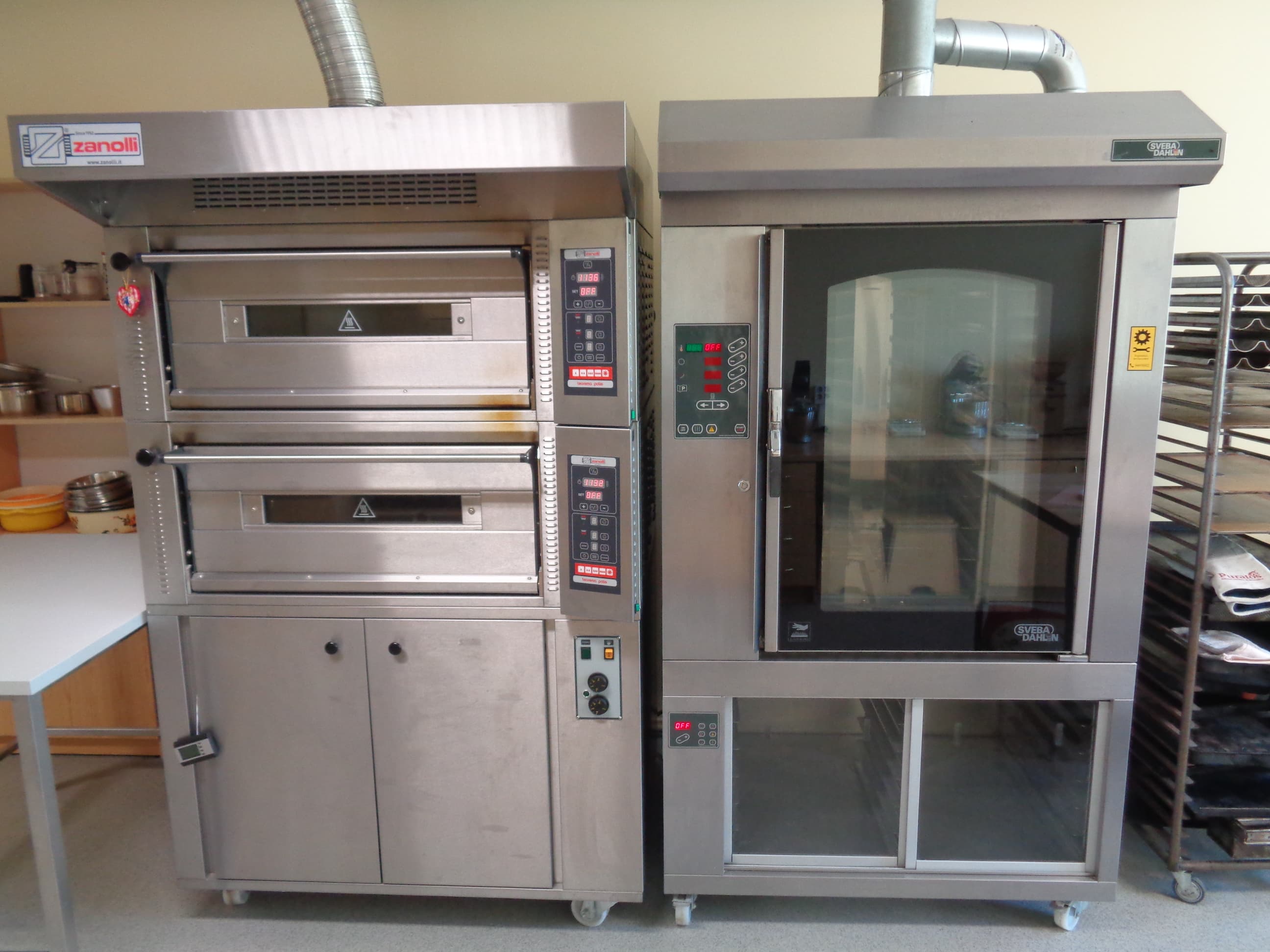
This is the question every new bakery asks. Both bake bread, but they suit different production styles. A deck oven bakes directly on a heated stone or steel deck. Each deck is its own chamber, so you can run different products at different temperatures, and the stone gives bread a strong base crust. A rotary rack oven takes a whole trolley of loaded trays that rotates inside the chamber, so large batches bake evenly with less hands-on loading.
Our bakery deck oven is a stone-hearth unit with two to four decks, up to 300 °C per deck and up to 12 trays per deck, in electric or gas. It suits an artisan bakery or a cafe baking several products through the day. A rotary is the better answer once your output is about trolleys rather than trays, because loading stops being the bottleneck.
Deck vs rotary rack vs tunnel oven
Feature
Deck oven
Rotary rack oven
Tunnel oven
How it works
Stone or steel decks, each independent
One trolley turns in a hot-air chamber
Continuous belt through a heated tunnel
Strength
Crust, flexibility, mixed products
Even bake of large batches
Constant output with little labour
Weakness
Slower to load, more hands-on work
Needs trolley handling and space
Little flexibility, large investment
Footprint
Compact, stacks vertically
Large, plus a trolley area
A long line, often industrial
Utilities
Electric or gas
Electric, gas or diesel, with steam
Electric or gas, usually three-phase
Typical user
Artisan bakery, cafe, hotel pastry
Production bakery, supermarket
Central bakery, factory
Where do pizza ovens and tunnel ovens fit?
A pizza oven is a specialised deck oven built to run much hotter, because authentic Neapolitan-style pizza bakes in about a minute or two at roughly 400 °C and above. A stone-hearth deck oven rated to 300 °C is excellent for bread, flatbread, pan pizza and thicker styles, but it will not give you a Neapolitan bake. If your menu depends on that, tell the supplier the target temperature at the start.
A tunnel or conveyor oven is a continuous bake. Dough goes in one end on a belt and comes out the other at a steady rate. It is the right tool for pizza chains, large bakeries and central kitchens making thousands of items a day, and the wrong one for a single outlet. If you are weighing something at this scale, send us your volumes and we will tell you honestly whether it is something we can help source.
Pizzerias that bake a few dozen pizzas a day usually do better with a pizza deck oven than a conveyor.
Conveyor ovens earn their space at volume, where consistency and low labour matter more than flexibility.
Specialist ovens such as rotisserie, charcoal and speed ovens suit a single concept. Check what each does before assuming it can replace a general-purpose oven.
Gas or electric: utilities, ventilation and installation
Most oven types come in both. The right choice depends less on the oven than on the building behind it.
Electric ovens are simple to install where the power is available. Larger units are typically three-phase, so check the supply in your unit before you choose. A 10-level combi at 18.5 kW is a real load, as the product page shows.
Gas ovens need an approved gas line (LPG cylinders or a network connection) and proper combustion air and flue arrangements. Gas can be economical where tariffs and infrastructure suit, but compare it using your actual tariffs.
Ventilation. Every oven puts heat into the room, and gas and steam-producing ovens add combustion products or moisture. Ovens are normally placed under or connected to extraction, so confirm the arrangement with your MEP consultant. See our guide to kitchen hoods for how the airflow is worked out.
Water and drainage. Combi ovens, and any oven with steam, need a water supply and drain, with the right pipe connections in the right place.
Access and ceiling height. Rotary and tall deck ovens can be limited by door widths and ceiling height, so measure the delivery route before ordering.
What drives the cost of a commercial oven?
Prices vary widely, and we are not going to quote a range here, because the spread between models is wider than any single number would be useful for. These are the factors that move a quotation:
Type and size. Combi, rotary and tunnel ovens carry more technology than a basic convection oven.
Capacity. More levels or decks cost more, but cost per tray usually falls as capacity rises.
Steam and controls. A touch-screen controller, core probe and programme memory add cost and often pay back in consistency.
Self-cleaning. An automatic wash cycle costs more up front and saves labour every day.
Energy source. Gas and electric versions of the same model can differ in price and in installation cost.
Material and build. Fully stainless steel inside and out, thicker insulation and a heavier door cost more and last longer in a humid kitchen.
Installation extras. Hood, flue, water treatment, stand and delivery are often missing from the first quote. Ask for a list of what is included.
Which commercial oven should I buy? Work through these five steps
Use the steps below, then check your answer against the table.
Write down what you will bake or cook. List the five items that bring in most of your revenue and the temperature and moisture each one needs.
Estimate the peak batch. How many trays or trolleys must come out in your busiest hour? Size the oven for that hour, not the average one.
Check the room. Door width, ceiling height, floor loading, extraction, power or gas, water and drain.
Compare running costs. Compare gas and electric using your actual tariffs, and include cleaning and descaling labour.
Ask for the full scope. Make sure the quotation lists the hood, stand, trays, water treatment, delivery and commissioning.
Choosing an oven by business type
Business
First choice
Why
Also consider
Restaurant with a varied menu
Combi oven
Roast, steam, bake and regenerate in one unit
A convection oven for a second line
Hotel or banquet kitchen
Combi oven (large capacity)
Cook-and-hold and regenerating plated food for events
A deck oven for the pastry section
Cafe with pastry and cookies
Convection oven
Even baking, simple controls, lower cost
A combi if the menu has hot food
Artisan bakery or bread shop
Deck oven
Stone-hearth crust and flexible batches
A convection oven for pastry
Production bakery or supermarket
Rotary rack oven
Large, even batches
A deck for specialties
Pizzeria
Pizza deck oven
High, steady heat on a stone
Check the temperature you need first
Central kitchen or factory
Tunnel oven
Continuous output with little labour
Rotary ovens for lower volumes
Common oven buying mistakes
Buying capacity for the average day. Size it for the busiest hour, or your service backs up when it matters most.
Choosing a combi when you only bake. If bread and pastry are the menu, a deck or convection oven is often the better fit.
Assuming one oven does everything. A deck oven will not steam vegetables. A combi will not give a hearth crust on every bread. Decide on the main job.
Forgetting the hood. An oven adds heat, and some add steam or combustion gases. Plan the extraction before delivery.
Ignoring tray size. GN pans and bakery trays are not interchangeable. Match the oven to the pans you already own or plan to use.
Underestimating the electrical load. A large electric oven can need a dedicated three-phase supply. Check with an electrician early.
Skipping the cleaning plan. Decide who cleans and descales it, and how often, before the first service day.
Where it is used
Restaurants and hotel kitchens
A combi oven handles roasting, steaming and regenerating across a varied menu, and a stone deck oven can cover bread and pastry.
Cafes and patisseries
A convection oven covers pastry, cookies and roasting. Add a deck oven if bread or flatbread is part of the offer.
Artisan and neighbourhood bakeries
Stone-hearth decks give crust and the freedom to bake different products at different temperatures.
Production bakeries and supermarkets
Rotary rack ovens bake whole trolleys evenly, so output is planned in trolleys per hour rather than trays.
Pizzerias
A pizza deck oven gives a fast, high-heat bake. Confirm the target temperature for your style of pizza first.
Catering and central kitchens
Large combis for cook-and-hold and regenerating, with rotary or tunnel ovens when baked output reaches production scale.
Benefits
Type matched to menu and volume
The guide starts from what you cook and how much of it, rather than from a model number.
Real specifications on the product pages
Our combi oven and bakery deck oven list capacity, temperature range, power source and material, so you can compare them on the page.
SUS304 stainless construction
Both ovens are specified in SUS304, which suits humid kitchens and heavy daily cleaning.
Electric or gas
The combi oven and the deck oven are each available in electric or gas, so the choice follows your building.
Advice on the room around the oven
Hood, power, water and access are part of the conversation before you order, not after delivery.
Related products
Equipment from the FIAMMA range that goes with this page.
What is the difference between a combi oven and a convection oven?
A convection oven moves hot air around the food with a fan. A combi oven does the same and adds steam, with control over humidity, so it can steam, roast and bake in one machine. The combi costs more and needs a water connection.
Which is better for a bakery: deck oven or rotary oven?
A deck oven suits artisan bread and mixed products on a stone hearth, while a rotary rack oven bakes large batches evenly on trolleys. Small bakeries usually start with a deck. A rotary pays off once output is regular and in volume.
Which commercial oven should I buy for a new restaurant?
For a varied menu, a combi oven is usually the most flexible single choice. If the menu is mostly baking and roasting and budget is tight, a convection oven is simpler. List your five best-selling dishes first and choose the oven that suits them.
Is a gas or electric oven better?
Neither is better in general. It depends on the supply in your building and on tariffs. Electric is simpler to install where three-phase power is available. Gas needs an approved line and flue. Our combi oven and deck oven both come in either version.
How do I measure a commercial oven's capacity?
Combi ovens are measured in GN levels (for example 10 GN 1/1), convection ovens in sheet pans, deck ovens in trays per deck, and rotary ovens in trays per trolley. Count what you need in the busiest hour and size to that.
Do commercial ovens need a hood?
Usually they sit under or are connected to extraction, because they release heat and, with gas or steam, combustion gases or moisture. The right arrangement depends on the oven, the room and local rules, so confirm it with your MEP consultant. See our kitchen hood guide.
Can a deck oven make pizza?
Yes, for thicker and pan-style pizza and for flatbread. Our deck oven reaches up to 300 °C per deck. Neapolitan-style pizza is usually baked well above that, so choose a dedicated pizza oven if that is your menu.
Do I need a combi oven if I only bake?
Usually not. A deck or convection oven is simpler and cheaper for baking alone. A combi earns its place when the same oven must also steam, roast and regenerate food.
What electrical supply does a large oven need?
Larger electric ovens are typically three-phase, and a 10-level combi at 18.5 kW is a substantial load. Have your electrical consultant check the supply and breaker rating before you order.
Do you supply rotary, tunnel or pizza ovens?
Our live range includes a combi oven and a stone-hearth bakery deck oven. For rotary, tunnel or pizza ovens, send your volumes and menu through the contact page and we will tell you what we can help with.