Restaurants and cafés
An upright chiller and a freezer at the back of the line, a prep counter on the cold station. The cabinet that gets opened most should sit nearest the cooks and furthest from the heat.

A commercial chiller holds food at about +2 to +8 °C and a commercial freezer holds it at about -18 °C or lower. FIAMMA supplies SUS304 upright freezers, meat chillers, prep counters and pastry display chillers in Dubai. This guide explains how to pick the type, size and placement for UAE kitchen heat.
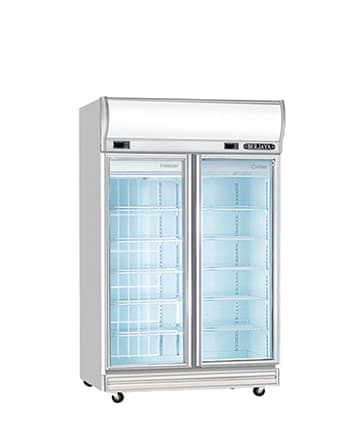
Ask three suppliers for a commercial freezer and you can get three different answers on temperature, refrigerant and what the unit is rated for. A lot of the confusion comes from a handful of words that mean different things in a home, in a plant room and in a kitchen. This page sorts them out, so you can compare quotations on facts instead of a photo and a price.
FIAMMA supplies SUS304 upright freezers, upright meat chillers, pizza and salad prep counters and pastry display chillers from Al Qusais, Dubai. Below you will find the temperature classes, which type fits which job, our range side by side, and what to ask before you pay. If you already know what you need, send it through the contact page. For a shorter explainer on the two terms, read our chiller vs freezer guide.
In a UAE kitchen, chiller means a refrigerated cabinet or counter that keeps food cold but not frozen. It does the job of a fridge, with a commercial compressor, a stainless steel body and doors built for hundreds of openings a day. It is not the water chiller used for building air conditioning or district cooling, and it is not a chiller van. A freezer keeps food frozen solid, and a commercial one is built to keep doing that in a hot room.
The temperatures below are typical working ranges. Your menu, your food safety plan and the authority's food code decide what you actually have to hold.
| Class | Typical holding range | What it holds | What to know |
|---|---|---|---|
| Chiller (storage or prep) | about +2 to +8 °C | Dairy, produce, sauces, prepared food, prep ingredients | Many kitchens set it toward the cold end, around +2 to +5 °C, so food never drifts to the warm end of the range. |
| Meat and fish chiller | about -2 to +4 °C | Fresh meat, poultry, fish | Colder than a general chiller. Even air flow matters, so one shelf does not freeze while another runs warm. |
| Display chiller | about +2 to +8 °C | Cakes, pastries, desserts, packed food on show | Glass and lighting add heat load. See our page on display chillers. |
| Freezer | about -18 °C or lower (often -18 to -22 °C) | Frozen stock, frozen proteins, fries, ice cream bases | Works hardest, uses the most electricity and suffers most from heat around it. |
The type decides how much you can store, how far a cook has to walk and how much floor you give up. Most kitchens end up with a mix of two or three.
| Type | Best for | Strength | Watch for |
|---|---|---|---|
| Upright (reach-in) chiller or freezer | Bulk storage near the line or in a back store | The most litres per square metre of floor, with full-height shelving | Every door opening dumps cold air. It needs headroom and clearance at the back. |
| Under-counter chiller or freezer | Small kitchens, bars and stations that need ingredients at hand | Doubles as a work surface and keeps stock within reach | Small volume. The compressor sits low and picks up floor dust and heat. |
| Prep counter (pizza or salad) | Pizza, salad and sandwich stations | Ingredients in GN pans at working height with a cold cabinet below | The pan well and lid decide how well the top stays cold in a warm room. |
| Display chiller | Cakes, pastries, desserts, grab-and-go | Sells the product while holding a steady temperature behind glass | Glass, lighting and sunlight add heat. See display chillers in Dubai. |
| Walk-in cold room | High-volume stores and central kitchens | The largest capacity | A built structure rather than a cabinet, and outside the scope of this page. |
These are the refrigeration units FIAMMA supplies today, with specifications exactly as listed on each product page. Where a page does not state a value, the table says so instead of guessing.
| Model | Type and size | Temperature | Refrigerant and electrical | Other points listed |
|---|---|---|---|---|
| Commercial Upright Freezer | Single door, 700 L, 740 × 830 × 2010 mm | -18 to -22 °C | Refrigerant not stated on the page. 220 V / 50 Hz / 780 W. Embraco heavy-duty compressor. | SUS304 inside and out, forced-air cooling, automatic defrost, 70 mm polyurethane insulation, Tropical Class T, up to 43 °C ambient. |
| Upright Meat Chiller | Double door, 1,400 L, 1480 × 830 × 2010 mm | -2 to +4 °C | Refrigerant and wattage not stated on the page. 220 V / 50 Hz. | SUS304, forced-air ventilation, automatic electric defrost, digital thermostat, internal lighting. |
| Pizza and Salad Prep Table | 9 × GN 1/3 pans, 1800 × 800 × 1050 mm | +2 to +8 °C | Listed as R134a / R290. 220 V / 50 Hz. | SUS304, retractable insulated hood, PE cutting board, nine SUS304 GN pans supplied with the 1.8 m model. |
| Pastry Display Chiller | 1200 × 750 × 1200 mm, curved double-glazed front | +2 to +8 °C | R290. 220 V / 50 Hz / 650 W. | SUS304 and double glass, defogging, warm LED on every level, fan cooling, automatic defrost. |
R290 is propane used as a refrigerant. It is a natural gas with a very low global warming potential, and it moves heat efficiently, which is why many newer commercial cabinets use it. Because propane is flammable, an R290 cabinet carries a small, strictly limited charge and should be installed and serviced by a technician who knows the gas. Older cabinets often use R134a or R404A. Those are not unsafe, they simply have a higher global warming potential. On FIAMMA's range the pastry display chiller is listed with R290 and the prep table as R134a / R290, so ask which applies to your unit.
Climate class is the standard way to say how hot and humid a room a cabinet was tested in. The classes you will see quoted most often are:
Work from what you store, not from the size of the room. As an indicative starting point, plan for two to three days of stock in a busy kitchen with frequent deliveries, and more if deliveries are weekly. Then remember that a cabinet's rated volume is gross. Usable shelf space is noticeably smaller, and a cabinet packed solid blocks the air flow it depends on.
A chiller or freezer is a heat pump. It moves heat out of the cabinet and releases it into the room, so a cabinet in a hot, cramped corner works harder to get the same result. These points make the biggest difference.
Two cabinets with the same litres and the same photo can behave very differently after a year in a hot kitchen. Ask for these in writing:
People search for 'freezers manufacturers' because they want to know who stands behind the cabinet. FIAMMA is a supplier of this refrigeration range, not the maker of the cabinets, and we would rather say so plainly. Our own custom work is stainless steel fabrication made to your drawing. In practice, ask any seller, us included, who builds the unit, where spare parts and service come from and what the written specification says. If you need a cabinet to a special size, say so at the start so we can tell you honestly whether it is something we can arrange. Our manufacturer vs supplier vs turnkey guide explains how the three models differ.
A typical enquiry runs like this:
An upright chiller and a freezer at the back of the line, a prep counter on the cold station. The cabinet that gets opened most should sit nearest the cooks and furthest from the heat.
Narrow menus and tight floor plans suit under-counter and prep-counter units that keep ingredients at the station.
Separate cabinets for raw meat, dairy and prepared food, with a cold room for bulk. Upright units serve the individual sections.
A ventilated meat chiller holding about -2 to +4 °C keeps fresh cuts cold without freezing them.
A GN-pan prep counter keeps toppings at working height and cold, with the cutting board where the cook assembles.
A glass display chiller for the shop floor and a back-of-house chiller or freezer for stock. See display chillers.
Each model's listed temperature, size, refrigerant and power are published, and where a value is not listed we say so and tell you to ask.
The upright freezer page states Tropical Class T and up to 43 °C ambient. For other models you get the ambient rating in writing before you buy.
The range is listed in SUS304, so cabinets match your work tables, shelves and counters.
Upright storage, a meat chiller, a prep counter and a pastry showcase from one supplier, so one conversation covers the cold side of the kitchen.
Counters, infill tables and shelves made to your drawing can be planned around the cabinets from the start.
Equipment from the FIAMMA range that goes with this page.

Single-door commercial upright freezer with forced-air ventilated cooling. Built with thick cyclopenthane insulation, self-closing magnetic door gaskets, digital control panel, and adjustable heavy-duty shelves. Designed to operate efficiently in hot kitchen environments up to 43°C ambient temperature.

Ventilated reach-in storage chiller specifically engineered for storing fresh meat and dairy products. Features a digital thermostat, auto evaporation tray, internal lighting, and high-performance compressor unit providing rapid cooling recovery when doors are opened.

Combination preparation table and under-counter chiller cabinet. Top section accommodates GN 1/3 cooling ingredient pans under a retractable insulated hood cover. Heavy-duty food-grade polyethylene cutting board runs along the front, providing an optimal workspace for assembling pizzas, salads, and sandwiches.

Premium glass-enclosed pastry showcase chiller designed for bakeries, coffee shops, and hotels. Features double-glazed curved front glass with defogging heaters, brilliant LED lighting under each glass shelf, automatic defrosting, and a high-efficiency digital thermostat. Dynamic fan cooling ensures stable temperature profiles.
Tell us what you store, the temperatures you need and where the unit will sit. We will match it to the range and confirm the specification in writing.
Last updated: