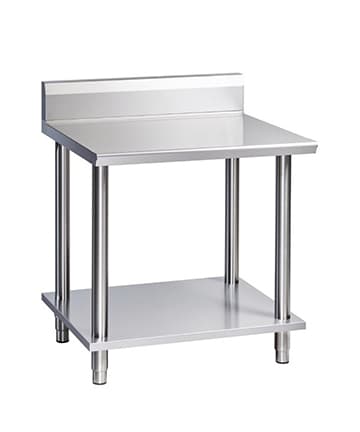
Commercial Stainless Steel Kitchen Cabinets in Dubai
Commercial kitchen cabinets are stainless steel storage units built for heat, steam, grease and daily washdown, not home joinery. FIAMMA supplies SUS304 wall cabinets with double-skinned sliding doors, wall shelves and tables, with base and tall units custom-fabricated to your drawing for restaurants, hotels and catering kitchens in Dubai.
Search for kitchen cabinets in Dubai and almost every result is home joinery: wood, laminate, soft-close doors, a showroom visit. A restaurant kitchen is a different job. The cabinet sits next to a dishwasher that releases steam, above a prep table that is hosed down daily, and under a ceiling that carries airborne grease. Cabinets built for a villa fail there within a year or two.
This page is about the commercial kind. It covers wall cabinets, base units and tall storage, sliding versus hinged doors, how stainless steel compares with aluminium, MDF and laminate in a hot, wet kitchen, how to fix and seal units, and what to put in your brief. If you want the wider picture of what can be made to drawing, see our page on custom kitchen fabrication.
How are commercial kitchen cabinets different from home kitchen cabinets?
The difference is not looks, it is what the cabinet has to survive. A commercial cabinet is judged on four things:
Water. It will be wiped or sprayed down every day, and sit near sinks and dishwashers. Any material that absorbs water eventually swells, rots or grows mould.
Heat and grease. Kitchen air carries oil, and some walls get warm. Surfaces must resist both without warping, peeling or turning sticky.
Hygiene. Every joint, edge and hinge is somewhere food and bacteria can hide. Smooth, welded, non-absorbent surfaces are easier to keep clean.
Load and abuse. Stock pots, chinaware and boxes are heavy, doors get banged and trolleys hit corners.
Wall cabinets, base units or tall storage: which do you need?
Most kitchens use all three, in different places. Here is how to decide where each belongs.
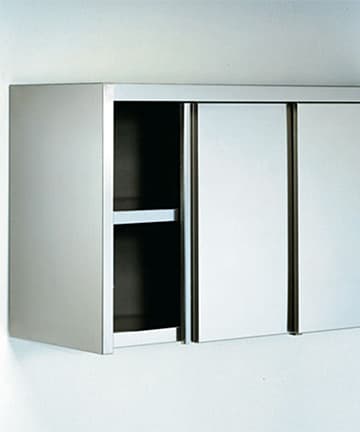
Wall cabinets keep spices, chinaware, small tools and packaging off the worktop and out of the dust and oil in the air. Our sliding-door wall cabinet is enclosed on all sides, with an adjustable intermediate shelf and rails that fix to the wall. It is 1200 × 400 × 600 mm as listed, and can be built to your size.
Base units sit under a worktop and give you closed storage for pots, containers and consumables. Where you only need open space for trays and containers, an infill table with an undershelf may be more practical. Base units are custom-fabricated to your drawing.
Tall units run floor to a working height for dry goods, cleaning supplies or uniforms. They suit back-of-house corridors and stores rather than the cooking line.
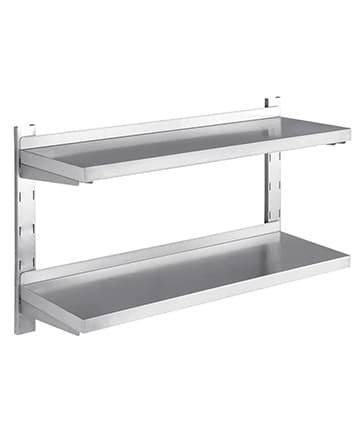
Open shelves, such as our wall-mounted shelf, are best for items used constantly and washed often, such as pots and containers.
Sliding doors or hinged doors in a commercial kitchen?
Both work. The right choice depends on the space in front of the cabinet and what is stored inside.
Sliding doors compared with hinged doors on commercial cabinets
Door type
Best for
Watch out for
Sliding doors
Narrow aisles and tight cooking lines, where a swinging door would hit a person or a trolley. Wall cabinets above worktops.
Only half the opening is accessible at a time. Tracks need cleaning, so ask for a design where they can be reached and lifted out.
Hinged doors
Base units and tall storage where you want the full opening, and wide aisles.
Needs clear swing space. Hinges are another joint to keep clean, and a door left open can be knocked.
Stainless steel, aluminium, MDF or laminate: which material survives a commercial kitchen?
Material choice is where cheap cabinets are made. This table compares the four you will be offered, in the conditions that matter in a UAE commercial kitchen. It is a general comparison, not a test result.
Cabinet materials compared in humid, hot and wet commercial kitchens
Material
Humidity and wet areas
Heat near cooking
Cleaning and hygiene
Overall for a commercial kitchen
SUS304 stainless steel
Does not absorb water. Handles daily washdown and steam.
No warping or peeling at normal kitchen temperatures.
Non-absorbent. Wipes and sanitises easily. Welded joints leave no crevices.
The standard choice. Higher upfront cost and weight, and shows fingerprints.
Aluminium
Does not rust, but strong alkaline cleaners and salt can pit and stain it.
Copes with heat, but softens and dents more easily.
Non-absorbent, but scratches and dents collect dirt.
Fine for light, dry storage. Less suited to heavy loads or harsh washdown.
MDF or wood
Absorbs water. Swells and breaks down at edges and joints, especially at the base.
Dries, cracks and can scorch near heat.
Damaged surfaces hold moisture and bacteria. Hard to sanitise fully.
Not suited to wet or hot areas. Sometimes used in dry front-of-house storage.
Laminate-faced board
The face resists water, but once edges chip, water reaches the core and it swells.
Heat can lift the laminate and soften the edge banding.
Easy to wipe while intact. Chips and lifted edges trap dirt.
A short life in a busy kitchen, and impossible to repair well.
How do you keep stainless cabinets hygienic, and how should the base be sealed?
A stainless cabinet is only as hygienic as its details. Cleaners and inspectors look at the same places:
Welded, ground corners instead of open seams, so there is no gap for water and food waste.
Recessed handles and smooth faces, so cloths do not snag and grease does not collect around a protruding handle.
Enclosed back panel. A fully enclosed back stops dust and grease reaching what is stored inside, as our wall cabinet's does.
At the floor, choose one of two approaches. Units on adjustable feet leave a gap you can clean underneath, typically around 150 mm. Units on a sealed plinth have no gap at all. Wet kitchens and sites with pest concerns often prefer the sealed plinth, while open-leg units suit kitchens that mop daily.
At the wall, seal the junction. Where a cabinet or shelf meets a wall, a food-safe sealant bead closes the gap so water and crumbs do not collect behind it.
Level the unit. Adjustable feet or levelling on the base keep doors sliding true and stop water pooling in a corner.
How much weight can a cabinet carry, and how should it be fixed to the wall?
Wall cabinets carry heavy things: chinaware, stacked containers, cans. The load is carried by the fixing, not the box, so ask about the wall as well as the cabinet.
Check the wall first. Concrete and solid block walls take anchors well. Light partitions, gypsum or tiled stud walls need a reinforced backing or a different solution. Say what the wall is made of when you send the brief.
Check the fixing. Heavy wall rails or brackets, anchored at several points, spread the load. As a guide, the listing for our wall-mounted shelf says a standard 1200 mm shelf anchored into concrete can carry roughly 60 to 80 kg of evenly spread weight. Confirm figures for your own wall and your own stored items.
Spread the load. Put heavy items on lower shelves, and keep the weight evenly spread rather than concentrated at one end.
Layout tips: where cabinets should and should not go
Where a cabinet sits matters as much as what it is made of. These tips avoid the most common problems.
Keep wall cabinets away from the cooking line. Heat and grease collect over fryers and ranges, and the area under the hood is for ventilation. Read our guide to commercial kitchen hoods before placing storage above a line.
Keep storage away from steam. Dishwasher outlets and kettles load the air with moisture. Put dry goods elsewhere.
Leave a working gap. A clear space of roughly 450 mm or more between the worktop and the underside of a wall cabinet is a common rule of thumb. Check that staff can reach the lowest shelf without a step.
Plan the door. Sliding doors suit narrow aisles. Hinged doors need swing room.
Think about the trolley route. Rounded corners and a clear walking line prevent knocks.
Match the stainless. Wall cabinets, shelves and tables in the same finish give the kitchen one look. See our page on stainless steel kitchen equipment.
What to put in your brief for a commercial cabinet order
A good brief gets you an accurate quotation the first time. Follow these steps when you contact us.
Measure the wall or run. Give width, depth, height, and the position of any column, window, socket or pipe.
Say what is stored. Chinaware, spices, containers and cans have different weights. This sets the gauge, shelf count and fixing.
Choose the door type. Sliding or hinged, and how many doors per unit.
State the wall and floor type. Concrete, block, plasterboard or tile, and whether you want feet or a sealed plinth.
Give the finish and grade. SUS304 is standard. Mention if you want anything else.
Send everything. Use the contact page or WhatsApp with a drawing or dimensioned sketch. Ask for the lead time in your quotation.
Where it is used
Restaurant kitchens
Wall cabinets over prep areas for spices and small tools, base units under worktops for containers and consumables.
Hotel and banquet kitchens
Large quantities of chinaware and serviceware need robust, enclosed wall storage and tall stores in back-of-house areas.
Cloud kitchens
Small rooms need every wall used. Sliding doors let cabinets sit over narrow aisles without swing clearance.
Bakeries and pastry kitchens
Enclosed cabinets keep flour dust and airborne oil off decorating tools and packaging.
Catering and central kitchens
Heavy daily use and frequent washdown favour welded stainless units that do not swell or peel.
Staff canteens and camps
Robust enclosed storage with simple doors that a small team can keep clean.
Benefits
SUS304 stainless steel
Non-absorbent, easy to sanitise, and unaffected by steam and daily washdown.
Double-skinned sliding doors
Rigid, quiet and dent-resistant, with recessed handles that do not snag.
Fully enclosed
A closed back and doors keep dust and airborne oil off what is stored inside.
Made to your wall
Width, depth and shelf layout follow your drawing, with wall rails planned for your wall type.
Matches the rest of your stainless
Same SUS304 as our tables, shelves and hoods, so the kitchen looks and cleans as one.
Related products
Equipment from the FIAMMA range that goes with this page.
They are storage units built for professional kitchens, normally in stainless steel, designed to withstand heat, steam, grease and daily washing. They differ from home cabinets in material, construction and fixing.
Are stainless steel cabinets good for a commercial kitchen?
Yes. Stainless steel does not absorb water, resists heat and grease, wipes clean and has no coating to peel. SUS304 is the standard grade for food areas.
Will stainless steel cabinets rust in Dubai's humidity?
SUS304 resists corrosion in normal kitchen humidity. For salt-laden sites or heavy chemical cleaning, ask about SUS316. Keep surfaces dry where possible and avoid leaving chlorine-based cleaners on the steel.
Should I choose sliding or hinged doors?
Sliding doors suit narrow aisles and wall cabinets where a swinging door would be in the way. Hinged doors suit base units and tall storage where you want the full opening. See the comparison table above.
What are the sizes of your wall cabinet?
The listed wall cabinet with sliding doors is 1200 × 400 × 600 mm, in SUS304 with one adjustable shelf. It can be custom-fabricated to other sizes. Send your wall dimensions.
Can you make base units and tall cabinets?
Yes, to your drawing. Send the dimensions, door type, shelf count and how the unit sits at the floor, on feet or on a sealed plinth.
How much weight can a wall cabinet hold?
It depends on the unit, the fixing and the wall. For reference, our wall shelf listing says a standard 1200 mm shelf anchored into concrete can carry roughly 60 to 80 kg of evenly spread weight. Tell us what you will store and what the wall is made of.
How should a stainless cabinet be cleaned?
Wipe with warm water and a mild detergent, then rinse and dry, working along the grain. Avoid steel wool and strong chlorine cleaners. Clean the door tracks and the junction with the wall as well.
How do I fix a cabinet to a plasterboard partition?
Not directly. A loaded stainless cabinet needs a backing plate or reinforced studs. Concrete and solid block walls are far better. Confirm the wall type before the cabinet is made.
Do you supply kitchen cabinets outside Dubai?
Yes. We supply across the UAE, including Abu Dhabi, Sharjah, Ajman, Ras Al Khaimah, Fujairah and Umm Al Quwain.