Restaurants and QSR outlets
A single line of range, fryers and griddle needs one properly sized wall canopy. Getting the length right avoids oversizing the fan, which saves running cost for years.

A commercial kitchen hood is a stainless steel canopy over your cooking line that captures heat, smoke and grease and passes them to the exhaust duct. FIAMMA is a Dubai manufacturer and supplier of custom SUS304 extraction hoods, cut to the length of your line, with baffle grease filters and an optional built-in water mist line.
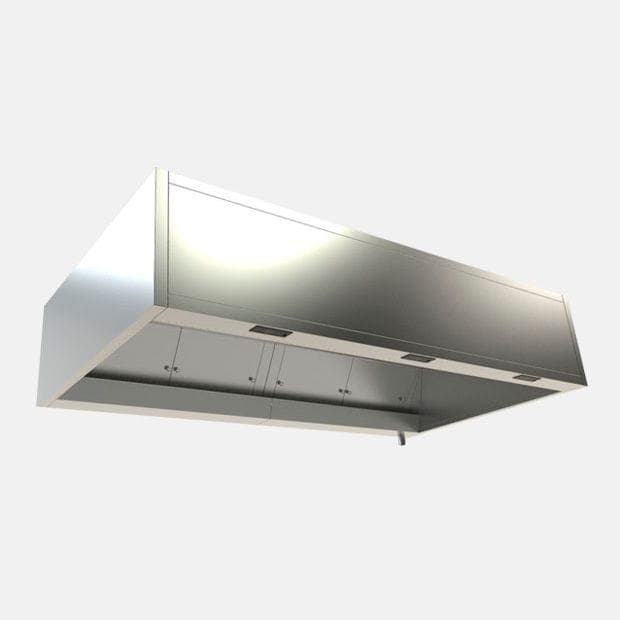
Most hood problems start before anything is fabricated. The hood gets drawn while the cooking line is still changing, the length is rounded to a standard size, and the airflow is guessed from the room instead of the equipment underneath it. Six months after opening, the kitchen is hot, the filters are dripping and the exhaust fan is either screaming or too weak to do its job.
This page walks through how a hood works, which type suits which kitchen, and how to size one properly, so that the drawing you send us (or your MEP contractor) is right the first time. If you already have your equipment schedule, you can skip straight to the quote request. If you are still deciding between a standard hood and one with built-in fire suppression, read our guide to water mist hoods as well.
A hood is not just a cover. It is the first part of a system that has to move air in a controlled way, and it does five jobs at once:
There are four types you will meet on most commercial projects in the UAE. The right one depends on what is under it and where the cooking line sits in the room.
| Hood type | Typical position | Suits | Things to know |
|---|---|---|---|
| Wall-mounted canopy | Against a wall, over a cooking line | Ranges, fryers, griddles, ovens in restaurant and hotel kitchens | The most common type. Wall acts as a back panel, so it captures well with less airflow per metre. |
| Island canopy | Free-standing, open on all sides | Central cooking islands, open-kitchen concepts, food-court layouts | Needs more airflow per metre than a wall canopy because air can be pulled in from every side. |
| Condensate (Type II) hood | Over dishwashers, steamers, some ovens | Steam and heat with no grease load | No grease filters needed in most designs; the aim is to remove steam and moisture. |
| Water mist hood | Same positions as wall or island canopies | Kitchens that want suppression built into the hood | Adds a water mist line and nozzles inside the canopy. See our water mist hood page. |
Sizing comes down to three numbers: how long the hood is, how far it overhangs the cooking surface, and how many cubic metres of air per hour it needs to move.
Length and overhang. The hood should be at least as long as the cooking line underneath it, plus an overhang on every open side. A minimum of around 150 mm beyond the cooking surface is commonly used, and many designers go to 300 mm for fryers and charbroilers because they throw more heat and vapour sideways. The lower edge of the hood is normally set so that it sits roughly 1.9 to 2.1 m above the floor, and not much more than about 1.2 m above the cooking surface.
Airflow. Airflow depends on how hard the equipment works, not on the size of the room. Designers group appliances into duty classes. The figures below are rounded, indicative values for a wall-mounted canopy, drawn from widely used ventilation design tables. They are a starting point for a conversation with your consultant, not a substitute for the calculation.
| Duty class | Typical appliances | Indicative airflow (m³/h per metre) |
|---|---|---|
| Light | Ovens, steamers, bain-marie, kettles | about 1,100 |
| Medium | Gas ranges, griddles, fryers, bratt pans | about 1,700 |
| Heavy | Charbroilers, woks, upright broilers | about 2,200 |
| Extra heavy | Solid-fuel cooking (charcoal, wood-fired) | about 3,000 |
Two hoods of the same length can be very different products. When you compare quotations, these are the points that decide how the hood behaves after two years of daily use:
Commercial cooking hoods and their ducts are a fire-safety item. In the UAE they are reviewed as part of the fit-out approval, and designs commonly follow the principles of NFPA 96 (the standard for ventilation control of commercial cooking). Requirements differ between emirates, free zones and building types, so the approval route for your project is something to confirm with your fire consultant and Civil Defence rather than assume.
What we can say for certain is how the hood is built: removable baffle filters, a welded drip channel, and, if you want it, a water mist line planned into the hood during fabrication so that the nozzles sit over the filter bank and the duct collar. Final approval of any suppression system rests with the authority, not with the fabricator.
A hood sits at the start of a chain. Once grease leaves the cooking line, three other things decide how well the kitchen runs:
The duct and fan need to carry the airflow you sized for, with access doors for cleaning. The grease trap under your pot-wash and pre-rinse sinks stops fats and oils reaching the drain, see our stainless steel grease traps. And the cooking equipment itself, from a commercial cooking range to fryers, decides which duty class the hood has to be designed for.
If you are building a complete line, our custom stainless steel fabrication service covers work tables, counters and wall shelving in the same SUS304, so the whole kitchen matches.
A single line of range, fryers and griddle needs one properly sized wall canopy. Getting the length right avoids oversizing the fan, which saves running cost for years.
Hotels run several cooking lines at once, often with different duty classes. Each line gets its own hood length and airflow so one heavy station does not starve the rest.
Tight floor plans and continuous frying make capture efficiency matter. A hood cut to the exact equipment width avoids wasted space.
Long cooking lines and heavy output call for island or extended canopies, with easy-clean filters to keep downtime short.
Island canopies and neat stainless finishes suit kitchens that are on show to customers.
Robust, simple hoods with removable filters that a small maintenance team can look after.
Length, depth and collar position follow your drawing, so there are no gaps at the ends and no oversized hood eating fan capacity.
Proper capture keeps heat and grease at the cooking line instead of in the room.
Removable baffle filters, a welded drip channel and a grease cup keep daily cleaning to minutes.
Same SUS304 finish as your work tables, shelving and counters, and dimensions agreed with your MEP team.
If you want a water mist line, it is designed into the canopy during fabrication.
Equipment from the FIAMMA range that goes with this page.

Heavy-duty SUS304 stainless steel extraction canopy engineered for high-heat commercial cooking lines. Integrated baffle grease filters, welded drip channels, and an optional built-in water mist fire suppression manifold contain grease-laden vapor and suppress flare-ups at the source, keeping kitchens compliant with UAE Civil Defence fire-safety codes.

Under-sink or in-line stainless steel grease trap engineered to intercept fats, oils, and grease before wastewater reaches municipal drainage. Baffled internal chambers slow flow to separate FOG from water, helping commercial kitchens meet UAE municipality drainage compliance and avoid blocked lines.
Send your equipment list and layout. We will confirm the hood length and duty class and come back with a drawing and quotation.
Last updated: