Hospitals and care facilities
Strict timing, special diets and clean-dirty separation. Cook-chill, tray assembly and reliable wash-up are the core.

An industrial kitchen solution is a kitchen planned around volume: receiving, cold store, preparation, batch cooking, chilling, dispatch and wash-up laid out as one flow. FIAMMA supplies the batch-cooking, cold, wash-up and custom SUS304 stainless equipment for central kitchens, staff catering and institutional catering, planned together with your consultant.
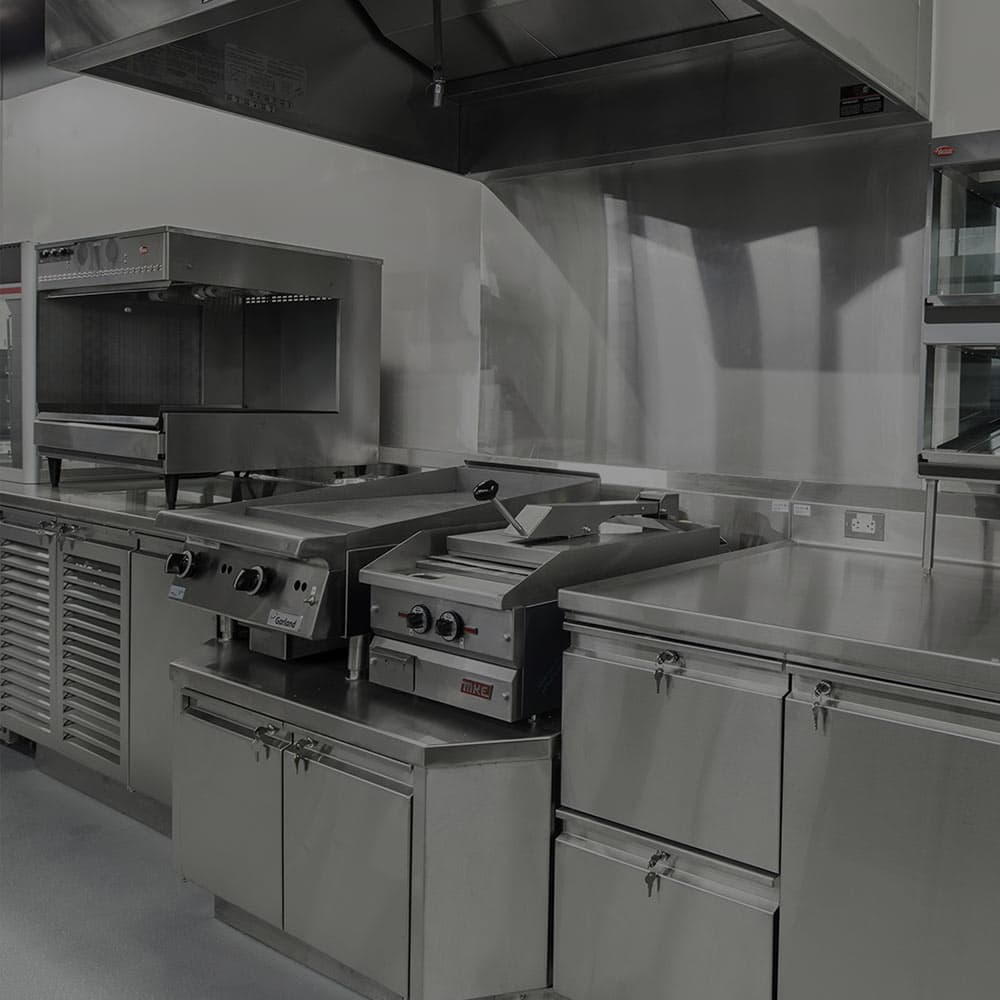
An industrial kitchen is not a bigger restaurant kitchen. A restaurant cooks to order for a few hundred covers a day. A central or industrial kitchen cooks to a schedule for thousands of meals, often for other places to serve, and what decides success is flow: where food enters, how it moves, how long it waits and how quickly it is chilled or dispatched.
This page covers who needs an industrial kitchen, how the process flow works, how to estimate throughput, what automated kitchen equipment realistically means and how custom stainless steel fits in. We supply a defined range of equipment, so where a project needs something outside it, we say so rather than stretch the claim. If you already have a brief or a consultant's drawing, send it through the contact page.
An industrial kitchen solution is the complete set of equipment, stainless fabrication and layout needed to produce large volumes of food repeatably. It is bought as a system, not as separate items, because the weakest stage sets the output of the whole kitchen. These are the operations that usually need one:
Good industrial kitchens are laid out in a line, or a U, so that food moves forward and never crosses back over cooked or ready-to-eat product. The table follows the flow stage by stage, with the equipment that normally belongs there and the planning point most often missed.
| Stage | Equipment | Planning note |
|---|---|---|
| Receiving | Receiving dock, scales, stainless receiving tables, wash-down area | Keep it away from cooked-food routes. Check vehicle access and the temperature of arriving goods. |
| Cold and dry storage | Cold rooms, upright chillers and freezers, shelving | Size chilled volume for days of stock, not hours. Upright freezer and meat chiller cover reach-in storage; see commercial chillers and freezers. |
| Preparation | Prep tables, food processors, slicers, vegetable cutters | Separate raw meat, vegetables and ready-to-eat zones. The listed food processor is rated up to 150 kg/hour. |
| Cooking | Combi ovens, bratt pans, fryers and ranges under extraction | Match the hood to the heaviest duty on the line and add up the connected load. See kitchen hoods. |
| Blast chilling and portioning | Blast chillers, portioning tables, packing and sealing | Cook-chill depends on fast chilling. Blast chillers are not in our current product list, so ask for a quotation if you need them. |
| Dispatch | Dispatch chillers, loading bay, trolleys, labelling area | Hold at temperature until the vehicle is ready. Plan the bay width for the trolleys you actually use. |
| Wash-up | Pre-rinse, hood-type dishwasher, pot-wash sinks, grease interceptor | Keep the dirty return separate from clean production. See commercial dishwashers. |
Throughput planning is arithmetic, and it is worth doing before any equipment is chosen. The method below works for most production kitchens. The numbers in the example are planning assumptions, so replace them with your own menu data.
People searching for automated kitchen equipment usually mean one of three things: robotic cooking units, connected equipment with programs and sensors, or food-processing machines. FIAMMA does not list robotic cooking or fully automated production lines. What the range offers is the practical automation that already exists in good commercial equipment, which is where most production kitchens actually save labour and cut variation.
The table separates what each feature does from what it does not do, so you can judge it against your own labour model.
| Feature | Where you find it | What it does for you | Limits to know |
|---|---|---|---|
| Programmable cooking | Combi oven: touch-screen controls, humidity control, multi-point core probe | Stores programs so each shift gets the same result, and cooks to core temperature | Programs must be set up and staff trained. People still load and unload. |
| Automatic cleaning cycle | Combi oven automated washing cycle | Cuts manual scrubbing time at the end of a shift | Needs water, a drain and the cleaning product the manufacturer specifies. |
| Automatic dosing and timed programs | Hood-type dishwasher: dosing pump, 60, 90 and 120 second programs, booster heater | Consistent detergent and rinse aid use, and a hot final rinse at 80 to 85 °C | Racks are still loaded by hand, and hot water must be available. |
| Independent temperature control | Double-well fryer: thermostat per well, safety thermostats | Two items cooked at their own temperatures at the same time | Not an automated frying line. An operator still lifts and loads baskets. |
| Large-batch cooking | Bratt pan, 80 L, tilting | Cooks and empties a large batch in one go | The listed pan tilts by a manual handwheel and does not stir itself. |
| Digital control and monitoring | Upright freezer digital control panel and similar chiller controls | Shows and controls the set temperature | Data logging and alarms usually come from a separate monitoring system added by your contractor. |
| High-speed cutting | Food processor, up to 150 kg/hour | Handles vegetable preparation volumes that would take a team hours | Operator-fed. It is a machine, not a robot. |
Industrial kitchens are rarely standard rooms, and a lot of the equipment inside them is stainless steel made to fit. FIAMMA supplies custom SUS304 fabrication to your drawing, covering the parts that catalogue equipment cannot.
The main items are work tables and infill tables between appliances, pass counters between hot and cold areas, wall shelving and cabinets, and the extraction hood over the cooking line. Our kitchen extraction hood is SUS304 at 1.2 mm with removable baffle filters, custom lengths from 1.2 m to 6 m or more and airflow up to 4,500 m³/h depending on the model, so long production lines can be covered with one or more hoods sized to the duty. The infill table is SUS304 with a 100 mm backsplash as standard.
Two stages decide whether an industrial kitchen runs smoothly at volume: how fast cooked food is chilled, and how fast everything is washed.
On an industrial kitchen, the kitchen supplier is one member of a team. Knowing who decides what avoids most of the delays.
A central kitchen supplies other people, so downtime is expensive. Planning for maintenance is part of the equipment decision.
Strict timing, special diets and clean-dirty separation. Cook-chill, tray assembly and reliable wash-up are the core.
Thousands of meals on a narrow menu, with robust batch equipment and easy-to-clean stainless.
Production for service elsewhere, where chilling speed and dispatch timing matter as much as cooking.
Shared preparation, cold storage and wash-up serving several brands from one layout.
One base supplying outlets and events, planned around throughput and dispatch.
Fixed service windows and large single services that favour programmable ovens and a wash-up line sized to the peak.
Stages are sized against each other so no one machine caps the kitchen's output.
Programmable ovens, dosing dishwashers and temperature control, described with their limits, not as robots.
Tables, shelves and hoods are fabricated to your drawing, so there are no dead gaps around columns and drains.
Throughput examples show every assumption, so your consultant can replace them with real data.
Equipment schedules and dimensions are shared early with your consultant and MEP contractor, when changes are cheap.
Equipment from the FIAMMA range that goes with this page.

High-performance smart combi oven combining convection heating and steam injection for versatile cooking, roasting, baking, and steaming. Features an advanced touch-screen control panel, automated washing cycle, precise humidity control, and multi-point core temperature probe. Ideal for high-end restaurants, hotels, and catering centers demanding consistency and speed.

Heavy-duty tilting bratt pan designed for braising, shallow frying, boiling, stewing, and simmering large batches of food. Features a manual handwheel tilting mechanism, thick compound steel base for uniform heat distribution, and high-efficiency heating elements. Built with double-skinned insulated lid for thermal efficiency.

Heavy-duty commercial food processor and vegetable prep machine. Features a wide hopper for large ingredients, continuous feed chute, and safety micro-switches to prevent operation when open. Comes with interchangeable disc blades for slicing, dicing, grating, shredding, and julienning.

Single-door commercial upright freezer with forced-air ventilated cooling. Built with thick cyclopenthane insulation, self-closing magnetic door gaskets, digital control panel, and adjustable heavy-duty shelves. Designed to operate efficiently in hot kitchen environments up to 43°C ambient temperature.

Heavy-duty commercial pass-through hood type dishwasher designed for inline installations with entry and exit tables. Features a high-pressure wash pump, automated dosing pump for rinse aid and detergent, 3 wash programs (60, 90, 120 seconds), and built-in booster heater for 85°C sanitizing final rinse.

Heavy-duty SUS304 stainless steel extraction canopy engineered for high-heat commercial cooking lines. Integrated baffle grease filters, welded drip channels, and an optional built-in water mist fire suppression manifold contain grease-laden vapor and suppress flare-ups at the source, keeping kitchens compliant with UAE Civil Defence fire-safety codes.

Custom manufactured stainless steel infill work table. Ideal for filling gaps between heavy cooking appliances or creating dedicated prep stations. Constructed from premium heavy-gauge SUS304 stainless steel with sound-deadening under-panel reinforcement, adjustable bullet feet, and a rear backsplash to keep walls clean.
Send your meals per day, your layout and any consultant drawings. We will confirm the equipment and custom stainless we can supply and come back with a quotation.
Last updated: