Custom fabricated equipment · SUS304

Custom Stainless Steel Kitchen Fabrication in Dubai

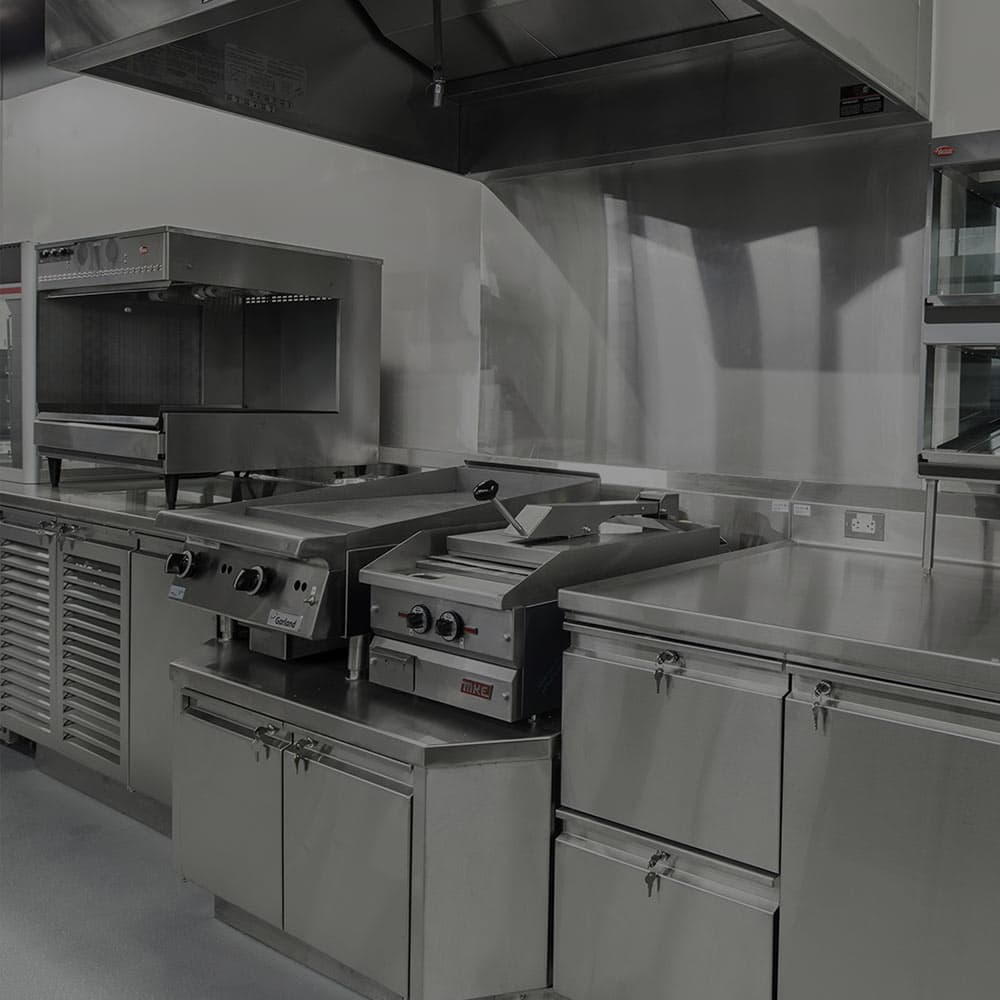
Custom kitchen fabrication means stainless steel equipment cut, folded and welded to your drawing instead of picked from a catalogue size. FIAMMA supplies SUS304 work tables, pass counters, wall cabinets, shelves and extraction hoods custom-fabricated to your layout, so every unit fits its wall, its appliance and its services.

Custom Stainless Steel Kitchen Fabrication in Dubai

Most commercial kitchens are not a clean rectangle. There is a column where the table should go, a gap of 640 mm between two appliances, a gas pipe that rises exactly where a shelf was drawn. Catalogue equipment forces you to work around those details. Custom fabrication lets the equipment work around them instead.

This page covers what can be made to drawing, when custom is the better choice, which gauges and finishes to specify, the hygiene details that matter, and how an order runs from drawing to installation. It also explains what to send with an enquiry so the first quotation is a useful one. If you are still comparing grades of stainless, read our SUS304 vs SUS316 guide first.

What kitchen equipment can be custom-fabricated to your drawing?

Almost anything built from stainless sheet and tube. These are the items kitchens most often ask for, with the FIAMMA product page for each where it exists:

When does custom fabrication beat catalogue equipment?

Catalogue units are the right answer when your layout is a plain rectangle and a standard width fits. Custom is worth the conversation in these situations:

  • Odd gaps and tight rooms. An infill table that is 640 mm wide, or a wall cabinet that stops short of a column, uses space a catalogue unit would waste.
  • Services in the way. Cut-outs and positions for sinks, drains, gas, electrical points and waste chutes are drawn in rather than drilled on site.
  • Appliances that sit flush. A hood, a counter or a table that matches the exact length of a cooking line looks tidier and closes the gaps where grease collects.
  • Matching a concept. An open kitchen on show to customers benefits from the same finish and edge detail across every unit.
  • Repeat outlets. A chain with a standard layout can have one drawing fabricated several times, so each branch matches.

What gauge of stainless steel should each item use?

Gauge is the thickness of the sheet. Thicker steel is stiffer and quieter but heavier and costlier, so the aim is the right thickness for the job, not the thickest one. The table shows typical ranges. The FIAMMA figures are from our product pages; the others are common practice and should be confirmed in your quotation.

Typical stainless steel thickness by item
ItemTypical gaugeWhyFIAMMA example
Work table and infill table topsAbout 1.2 to 1.5 mm, with an under-panel for stiffnessTakes knife work and pot placement without drumming or dents.Infill table: SUS304, 1.2 mm, with a sound-deadening under-panel.
Pass and pick-up counter topsAbout 1.5 mm, on a reinforced frameCarries stacks of plates and heated units below.Pick-up counter: SUS304, 1.5 mm top, steel channel reinforcement.
Wall shelvesAbout 1.2 mm with folded edgesStiffness under load, with edges that are safe to touch.Wall-mounted shelf: SUS304, 1.2 mm, folded safe edges.
Cabinet bodies and doorsAbout 1.0 to 1.2 mm, doors double-skinnedRigid doors that slide quietly and resist knocks.Sliding-door wall cabinet: SUS304, double-skinned sliding doors.
Extraction hoodsAbout 1.2 mmResists drumming and warping near cooking heat.Extraction hood: SUS304, 1.2 mm.
Sinks and wash tablesAbout 1.2 to 1.5 mmConstant water, heat and impact from pots.Made to drawing. Ask for gauge in the quotation.

Finishes and welds: what to specify

Two units from the same sheet can look and clean very differently depending on how the metal is finished and joined. State these in your brief so they are priced and built the same way across the whole kitchen.

  • Grade. SUS304 is the standard for kitchen work and is what FIAMMA's custom equipment uses. SUS316 is a step up for harsher conditions such as salty or heavily chemical environments. See the SUS304 vs SUS316 guide.
  • Finish. A satin, brushed finish is common on worktops because it hides fine scratches and wipes clean. Specify the grain direction so it runs the same way on every unit.
  • Welds. Joints that show should be welded, ground smooth and polished so no groove is left to trap grease. A visible bead and a rough weld are where bacteria and dirt collect.
  • Edges. Folded, rounded edges are safer for staff than cut edges, and add stiffness to shelves and top panels.
  • Fixings. Heavy brackets and wall rails matter as much as the shelf. Ask what the wall fixing is and what it needs from the wall.

Hygiene design: what separates a good unit from a cheap one

Food safety inspectors and your own cleaners look at the same details. Good custom fabrication builds them in, because they cannot be fixed afterwards:

  • Coved corners and no open seams. Where a worktop meets a backsplash, the joint is welded and rounded rather than left as a gap that holds water and food.
  • Backsplash against the wall. Our infill table uses a 100 mm backsplash, which keeps splashes off the wall and the wall off the table.
  • Sloped surfaces and drains. Wash tables slope to the drain so water does not sit in a puddle.
  • Adjustable feet. Floors in commercial kitchens are rarely perfectly level. Adjustable bullet feet (the infill table gives up to 50 mm) allow levelling and make it possible to clean underneath.
  • Closed undersides and sealed junctions. Where a unit meets a wall or floor, the gap is sealed or closed, not left open for pests.
  • Sound-deadening panels. An under-panel on tops stops the hollow, drumming sound of thin sheet under heavy use.

How a custom fabrication order runs from drawing to installation

The process is simple, but the first two steps decide how smoothly the rest goes. We supply and custom-fabricate to your drawing as follows.

  1. Send the drawing and the equipment list. A PDF or CAD layout is ideal. A sketch with dimensions works for small jobs.
  2. We review the layout and raise anything that clashes with the appliances, services or walls, before any metal is cut.
  3. You receive a drawing and quotation that show sizes, gauge, finish and options. Ask for the lead time in your quotation.
  4. You approve the drawing. Changes are cheap on paper and expensive on the shop floor, so check every dimension against your site.
  5. The units are fabricated by cutting, folding, welding, grinding and finishing the stainless, then checked against the approved drawing.
  6. Delivery and installation. Units are delivered to site and positioned and levelled, and fixed to walls where needed, in coordination with your MEP and fit-out teams.

What should you send with a fabrication enquiry?

The more precise your information, the more useful the first quotation. This list covers what we need, and why:

Information to send with a custom fabrication enquiry
SendWhy we need it
Kitchen layout (PDF, CAD or a dimensioned sketch)To see the room, the wall lengths, columns and where each unit goes.
List of items with sizes (length, depth, height)To price accurately. Dimensions on our product pages are only starting points.
Appliances that sit in or next to the unitsTo size cut-outs and keep clearances for heat and servicing.
Service points (water, drain, gas, electric)So cut-outs and sink positions are drawn in, not drilled on site.
Load and use (for example heavy stock pots on shelves)To choose gauge, reinforcement and wall fixing.
Finish and grade preference (SUS304 or SUS316, satin finish)To price and build every unit the same way.
Any comments from your consultant, Civil Defence or the municipalitySo the units can be checked against them from the start.

How does fabrication coordinate with MEP and the rest of the fit-out?

Custom equipment touches the plumbing, gas, electrical and ventilation work. Most delays come from these handovers, not from the stainless itself. Four points are worth agreeing early:

  • Hood and ducts. The collar position on a kitchen hood must match where your duct comes down. Agree it on the drawing, not on site.
  • Drains and wash area. Sink positions, waste outlets and the grease trap should be coordinated with the plumber before the sinks are cut.
  • Gas and electrical points. Appliances such as a gas cooking range need clearances and isolation points that the surrounding tables must respect.
  • Site measurements. Walls and floors are rarely true. Confirm dimensions on site before you approve the drawing, and allow the feet and fixings to take up small differences.

Where it is used

Restaurants fitting out a tight cooking line

Infill tables, a matched hood and wall shelving cut to the exact width of the line, with no wasted gaps.

Hotel kitchens with several stations

Different stations need different counters and storage. One drawing set keeps finish and edge detail consistent across them.

Cloud and dark kitchens

Small rooms and fixed equipment sizes call for tables and shelves that use every centimetre.

Chains with a standard layout

One approved drawing can be fabricated again for each new branch, so every outlet is the same.

Cafes, bakeries and open kitchens

Pass counters and display-facing units that need to look neat as well as work hard.

Central kitchens and canteens

Heavier-duty tables, shelving and wash tables built for long shifts and frequent cleaning.

Benefits

Built to your layout

Sizes, cut-outs and positions follow your drawing, so units fit the room instead of the room adapting to units.

SUS304 throughout

Tables, counters, cabinets, shelves and hoods share one material and finish, so the kitchen matches.

Hygiene details built in

Backsplashes, folded edges, adjustable feet and welded corners are part of the design, not extras.

Reviewed before cutting

We raise clashes with services and appliances on the drawing, where changes cost the least.

One source for the whole stainless package

Hoods, tables, cabinets and shelves from one drawing set make coordination with MEP easier.

Related products

Equipment from the FIAMMA range that goes with this page.

Stainless Steel Infill Work Table

Stainless Steel Infill Work Table

Custom manufactured stainless steel infill work table. Ideal for filling gaps between heavy cooking appliances or creating dedicated prep stations. Constructed from premium heavy-gauge SUS304 stainless steel with sound-deadening under-panel reinforcement, adjustable bullet feet, and a rear backsplash to keep walls clean.

Custom Fabricated EquipmentView details →
Stainless Steel Pick-up Counter

Stainless Steel Pick-up Counter

Custom-made pass-through pickup counter for food presentation and plating. Engineered with a smooth satin-finish top, heavy-duty structural frame, and integrated overhead pass shelf options. Easily integrates hot cupboards, neutral storage, or drawer units below.

Custom Fabricated EquipmentView details →
Stainless Steel Wall Mounted Shelf

Stainless Steel Wall Mounted Shelf

High-strength wall mounted shelving units for commercial kitchens, pantries, and dishwashing areas. Designed to maximize overhead storage. Heavy-duty brackets ensure a stable hold under heavy kitchen loads. Smooth rounded corners prevent safety hazards.

Custom Fabricated EquipmentView details →
Wall Cabinet with Sliding Doors

Wall Cabinet with Sliding Doors

Enclosed wall-mounted storage cabinet featuring smooth-sliding double doors. Ideal for keeping spices, chinaware, and small prep tools protected from dust and airborne oils. Built with an internal adjustable shelf and secure wall mounting rails.

Custom Fabricated EquipmentView details →
Stainless Steel Kitchen Extraction Hood with Water Mist Suppression

Stainless Steel Kitchen Extraction Hood with Water Mist Suppression

Heavy-duty SUS304 stainless steel extraction canopy engineered for high-heat commercial cooking lines. Integrated baffle grease filters, welded drip channels, and an optional built-in water mist fire suppression manifold contain grease-laden vapor and suppress flare-ups at the source, keeping kitchens compliant with UAE Civil Defence fire-safety codes.

Custom Fabricated EquipmentView details →

Frequently asked questions

What does custom kitchen fabrication mean?
It means stainless steel equipment cut, folded and welded to your own drawing and dimensions, rather than chosen from fixed catalogue sizes. It suits kitchens with odd gaps, special services or a specific concept.
What can be customised in a commercial kitchen?
Work and infill tables, pass counters, wall cabinets and shelves, extraction hoods, sinks and wash tables, trolleys and bain-marie counters. Sizes, cut-outs, undershelves, drawers, GN pan slots and finishes can all be set to your layout.
Is custom fabrication more expensive than buying standard equipment?
Not always. For plain layouts a standard size is usually cheaper. Custom can save money when a standard unit would waste space or need on-site alterations. Send your drawing and we will quote it so you can compare.
What stainless steel grade do you use?
SUS304 is the standard for our custom-fabricated equipment. Ask us about SUS316 if your conditions call for it. Our SUS304 vs SUS316 guide explains the difference.
What thickness is the stainless steel?
It depends on the item. Our hoods, infill tables and wall shelves are 1.2 mm SUS304, and the pick-up counter has a 1.5 mm top. The quotation states the gauge for every item.
Do you work from a drawing, or can you help with the design?
Send what you have: a PDF, CAD file or a dimensioned sketch. We review it and raise any clashes with appliances, services or walls before fabrication.
How long does a custom order take?
It depends on the quantity and complexity of the items. Ask for the lead time in your quotation, and tell us your site deadline when you send the enquiry.
Can you match equipment I already have?
Often possible in height, depth and finish. Send photos and dimensions of the existing units so we can match edges and working heights.
Do you install the equipment as well?
Units are delivered to site and positioned in coordination with your MEP and fit-out teams. Ask for the installation scope in the quotation.
Do you fabricate outside Dubai?
Yes. We supply across the UAE, including Abu Dhabi, Sharjah, Ajman, Ras Al Khaimah, Fujairah and Umm Al Quwain.

Related guides and solutions

Have a layout that needs custom stainless units?

Send your drawing, a list of items and the sizes. We will review it, flag any clashes and come back with a drawing and quotation.

Last updated:

Chat with us